Sunday, July 15, 2018

How To Do A Set Of Logic Games

It's come to my attention that the Logic Games (or Analytical Reasoning) section of the LSAT is pretty difficult for most people. I had the good fortune of getting a book of just logic games a few months before I started actually prepping for the LSAT, and I drilled them enough so that they're my best section. 

There's a simple enough formula to answering most of the questions, and I'll take you through it step-by-step below. The sample problem I'm using is from the REA 2nd Edition Logic Games book (found on Amazon here). It's not endorsed by the LSAC (Law School Admission's Council), and in my opinion, the questions can be harder than the ones you see on the LSAT. That's not necessarily a bad thing, though; when you're prepping for a test you might prefer to study to a higher level than what you'll need to do, so that the test itself feels a little easier. 

Here's a set up for the rules of the set:


So the first thing to do is to set up a diagram based off of what we've learned in the question. Each school will be ranked 1-5 in each category, and no school can have the same rank in a category, so we can set up a chart that explains what that means. 


Next, we need to write out the rules in short hand, so that they can all be easily referred to during the test. There are some that affect the chart no matter what, and are now set, so we can go ahead and mark those in.
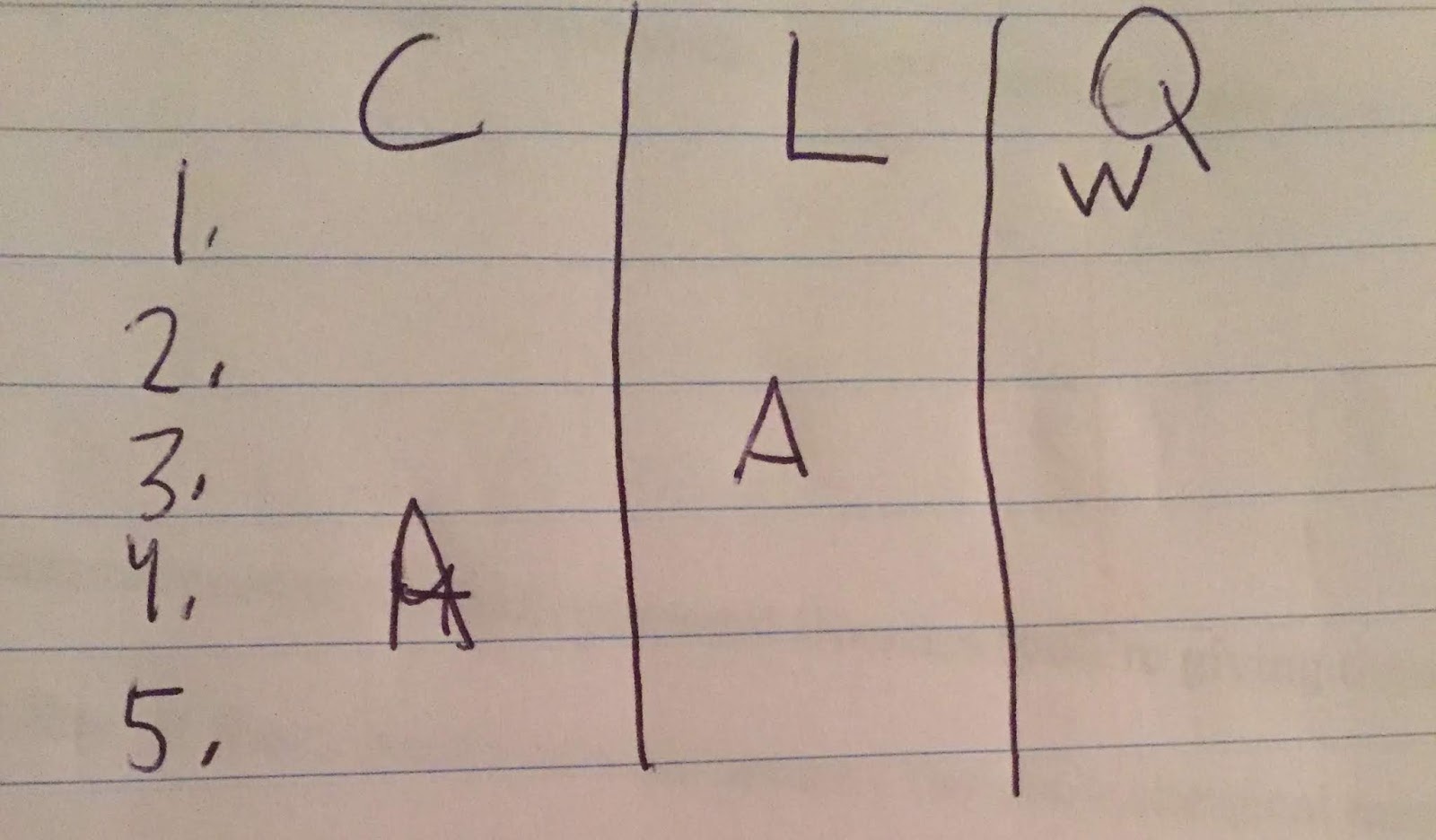


The other rules are about order, and don't let the different wording confuse you. They're saying the same thing. It doesn't matter what symbols that you choose to use to represent the rules, it only matters that you'll be able to remember them.


Next, we move on to the questions. Question #1:

(Note: Question #1 reads in full: Which of the following is a pair that can have no number 1 rankings?)

This one is pretty simple. We know that O has to be ranked below W at all times, so O cannot be ranked 1 in any categories. We also know that A is fixed in 4 and 3 in terms of Cost and Location, and W is 1 in Quality, so A cannot be ranked 1 either. Therefore, the answer is D.

This is why you want to be familiar with the rules and have your diagram written out; otherwise you'd have to go through each answer and see whether or not it was possible for each option to be ranked 1.

Question #2:


This question is trying to trick you, but if we look back at the rules, we'll realize that the condition about Ts ranking is superfluous. W must always be ranked higher than O. It doesn't matter where T is. W cannot be ranked 5. Therefore, the correct answer is E.

Again, have your rules written out in shorthand, right by you. All it takes is a quick glance to remember that W must always be higher than O.

Question #3:


This is a tough one, because it really just requires us to plug in every option and see whether or not it works. There's no way to get around these, except to be quick and have the rules close so that we can keep referring to them.

This first diagram proves that W can rank 2 in Cost, so A is not correct.


This second diagram proves that W can rank 2 in Location, so B is not correct. 


These next diagrams proves that O cannot rank 5 in Quality.


Because of the rule about O having to be lower than W, and the positions of the fixed As, either the O in Cost or Location must be in position five, and since no school can have the same rank in different categories, the O in Quality cannot be ranked 5. Therefore, the correct answer is C.

Once we've found the correct answer, we can move on to the next question. It can be handy to keep the diagrams we've already done close by, in case we need them for another question.

Question #4:


Now that we've got a conditional, we need to diagram out that conditional. But we can automatically strike answer A, since we know from Question #3 that O cannot be ranked 5 in Quality.

The tricky thing about these conditionals is that they don't ask which could be true, only which must be true. So the first thing to do is fill in what we know has to be true, given the condition. We get the following as our answer. 


When we compare that diagram, which must be true, to the options available, we see that O must be ranked 3 in Costs. Therefore, the correct answer must be C.

Question #5:


(Note: Question #5 reads in full: If S is ranked 2 in location, which of the following must be ranked 2 in quality?)

Another conditional. Based off of this, we can fill in the whole diagram:


Because of the condition on the position of S, and the rules we were given at the beginning of the set, we can see that O must be ranked 2 in Quality. Therefore, the correct answer must be D.

Question #6:


As with the last question, we'll fill in what we have so far. Be careful with the wording, though; this question doesn't ask what must be true, only what could be. Here's what we can deduce from the question:


It's simple to go through and eliminate what we know to be false because of this. 

O cannot be ranked 4 in Quality since it is already ranked 4 in Location, so B is incorrect. W cannot be ranked 3 in Location, since it is already ranked 2 in Location, so C is incorrect. T could not be ranked 3 in Cost, since W is ranked 3 in Cost, so D is incorrect. A cannot be ranked 4 in Quality, since it is already ranked 4 in Cost, so E is incorrect. There is only one answer remaining. Therefore, the correct answer must be A.

Question #7:


The first thing to do here is to figure out what the board looks like if these conditions are met. We can determine the whole board from them:


The only important thing to remember here is that 'lowest' really means numerically, not in the sense that a 5 would be the lowest ranking a school could get. That being said, you add them all up and you see that:

T = 5 + 1 + 4 = 10
S = 1 + 2 + 3 = 6
A = 4 + 3 + 5 = 12
O = 2 + 3 + 5 = 10
W = 1 + 2 + 4 = 7

So the school with the lowest score is S. Therefore, the correct answer is B.

I know it seems like a ridiculously frustrating method, but with practice, these questions really do get easier. You just have to remember to simplify the rules, build your set-up diagram, and mark the constants that are true no matter the question. Keep in mind that the questions are designed to trick you, so always look for the simplest solution first.

Tuesday, July 10, 2018

Law School and Mental Health

It's time to reveal a secret about myself: I am not omniscient. I depend on a lot of research to help me figure out what I'm doing with my life, and one of the sources I've been turning to frequently this past year is The Girl's Guide to Law School, a blog that has a lot of useful advice for both guys and girls who are applying to, are attending, or have recently graduated from law school. 

Recently they posted about the stigmatization of seeking help for mental health issues while in law school. They talk a lot about the way the structure of law school has become mechanized, and about how the Socratic method is a very useful way to teach, but that there is never going to be a 'one-size fits all' approach to education, and the fact that trying to force students to fit molds that do not work for them can increase mental health issues as stress levels rise.

Too frequently, when students do reach out for help, they're told that 'That's just the way it is' and that they have to toughen up, or perhaps consider that law school is not for them, which could cause talented people to quit when really they just need a professor who's willing to sit down with them and work a few things out. This mentality is a double-edged sword, though, in my opinion. Of course we want to accommodate people who aren't the cookie-cutter 'ideal', because that's how we ultimately attain diversity, which is so important in the legal field. 

At the same time, there is a legitimate argument to be made that if the stress of law school is too much for you to handle, the stress of a law firm would be equally as high. Isn't it better to figure out that this isn't the life for you when you're in 1L, rather than when you've spent three years earning a degree which you now can't use? Then again, plenty of people seek law degrees without planning to work at a BigLaw firm, and shutting them out of their education on that premise is just unfair.

There has to be a middle ground between maintaining a tough environment, and driving students into crisis.

One of the things I was surprised that the article didn't mention was the bar exam's mental health questions, which I know influence a lot of students' decisions to seek mental health or substance abuse assistance. The American Bar Association claims that the only disclosures required on the mental health section of the Character and Fitness Requirements are based around conduct or if an applicant has a serious disorder that would actively impair their ability to practice law, but when each section starts off with a reminder that a lack of transparency is grounds for dismissal, a lot of applicants feel pressure to disclose any sort of mental health issues they've ever experienced.

Recently, there has been a push to remove or heavily revise this segment of the bar exam. Multiple studies over the years have shown that the questions, which were initially intended to judge whether or not an applicant was capable of fairly representing their clients, actually have ended up driving law students away from seeking mental healthcare, for fear that they'd have to disclose the counseling.

Taking this into account alongside the issues raised in the Girl's Guide post, it seems that a structural overhaul is necessary for the sake of the mental health of prospective and current law students throughout the country. Professors can't be telling students that they need to suck it up when they're overly stressed or a class style for which there is no alternative isn't working for them. The bar exam needs to provide a way for students to seek basic mental healthcare without having to disclose the details of it during the bar exam, or being afraid that their disclosures will result in them being found ineligible to pass.

I do want to stress that no matter what your situation is, it's always better to seek help rather than to try to struggle alone. Even if you're afraid of the impact it will have on your Character and Fitness section, if you're struggling with mental health issues, you show maturity and responsibility to choosing to address them, and maintaining mental stability is more important than the potential repercussions.

If anyone here is struggling with mental health issues, here are a few resources and hotlines:

There are always options available to you.

Monday, July 9, 2018

Wikipedia is More Accurate Than Ever

I'm sure everyone here remembers my foray into the world of Wikipedia editing, but for those who might be new, here's a refresher: I found out-of-date information on the Wikipedia page for the LSAT, and corrected the page. You can read the whole crazy story here, if interested.

The sparknotes version is that the page hadn't been updated to reflect the fact that the LSAT would now be offered six times a year, rather than four, the previous standard. Today, I went back to check and see if my edits were still standing, and lo and behold, they were.


Although the page's intro already mentioned that more tests would be added in the 2018-2019 test cycle, I think it's important for common resources to be as detailed as they can be. I'm hopeful that the service I provided has helped more accurate information be disseminated. 

Sunday, July 8, 2018

Another Factor to Keep in Mind When Choosing a School

A few weeks ago, I wrote a post about the six factors to keep in mind when choosing a school. After doing more research, I'd like to add a seventh: Class size.

This can be applied two ways; both the size of the average class within the school and the amount of people per year can make a huge difference in your experience. There are pros and cons to each side, so you have to pick which aspects will work the best for you.

If you do better in small discussion groups where you have a lot of one-on-one time with the professor and other students, you're going to want to look at schools that tend to have very small classes. However, if you do well in lecture-style courses and know that you learn better when you are exposed to a diverse array of perspectives, larger class sizes might be what you're looking for, particularly if you check your school's diversity reports and see a highly-varied representation.

The number of people in your year at school can also seriously impact your experience. Schools with larger student bodies tend to have larger facilities, and offer a larger array of classes (this isn't always a given, but it's a good indicator). But larger doesn't always mean better, and if you're hoping to network while you're in school, it can be harder to make a splash in a bigger pool.

There's no single, correct answer for what everyone should pick. I know that I do well in individualized settings and want to have variety in my course options, so I tend to look at schools that have large student bodies and small class sizes. However, anyone considering law school should take a moment to reflect on their experience in undergrad or in other post-grad settings, and remember in which situations they've done the best.

Wednesday, July 4, 2018

The LSAT/GPA Paradigm

Whenever you apply for an academic program, you have to take into consideration whether or not you are qualified for it. I don't mean the out-and-out "bare minimum, graduated from a four-year university" qualifications, I mean whether or not the facts on you provide a strong enough basis for that program to accept you.

For us lawyer-hopefuls, those facts pretty much come down to our LSAT scores and our GPAs. It only takes a Google search to find the statistics on a school's admitted applicants, but sometimes it can be hard to properly understand how that criteria is applied. Does a 25th percentile GPA mean that you only have a chance of admission if your LSAT score is in the 75th percentile? Or is there still hope?

I found a program that tracks applicants' LSAT scores and GPAs together, and catalogues whether or not they were admitted. See an example below:


I picked Georgetown after reading that it is one of the most applied-to schools in America, so I figured that it would be the most relevant. You can check out the stats on your dream school here. 

It's good to know about where other applicants were in terms of both their scores, not just one or the other, so that we can be realistic about our prospects. For Georgetown, at least, a 25th percentile LSAT score (161) doesn't do you much good if you've also got a 25th percentile GPA (3.52).

Even though some of the data you may find could be disheartening, it's better to know than to blow the $50 on an application fee for a school where you don't have a chance. Then again, maybe you do. After all, there's almost always that one, hopeful little green dot in the lower or left-hand reaches of the screen. Maybe you could be that dot.

Monday, July 2, 2018

LSAT Prep Videos

I know I talk a lot about LSAT prep, and have done my best to give a rundown of what it's all about, but it occurs to me that I should probably let you guys see what the official LSAC (Law School Admissions Council) website says on the topic.


They've released a series of videos on the topics, you can find a link to the page with all of them here.

I do my best to give anyone reading this blog the best advice that I can, from an applicant's perspective, because I think it's valuable to hear about the process from someone going through it; there are things which occur to me that you might not pick up from asking someone who's been practicing law for decades and doesn't remember the minutia of the process.

That being said, it's important to turn to the experts for their advice as well. And the LSAC really is the best source for advice on the LSAT.

Sunday, July 1, 2018

Finding an LSAT Prep Course

Finding an LSAT prep course can be a bit confusing; it seems like Kaplan is everywhere and there aren't always other readily available options. I don't have any hard or fast rules for figuring out which course you should take, since that's a very individualized process, but I recently found a good way to learn about your options: The LSAT Center site.

As far as I can tell, LSAT Center isn't LSAC-certified, but if you put in your state or your zip-code, it lists out all of the major, reputable LSAT prep courses available near you, including tutoring centers and online options, which can come in handy considering how much sponsored ad-space the major companies buy on Google. Sometimes it seems like the whole first page of search results has been bought by advertisers.

Whichever course you choose has to depend on the amount of time you can devote to the process, how much work you need based on your practice tests, and what you know about your own style of learning. I'm taking an in-person course because I have time for bi-weekly classes that are a bit of a drive from my house, I want to get my score up at least five points from where my average is currently, and I don't do well in one-on-one environments long-term.

Any number of factors could go into why you choose the course that you do. But whatever those factors are, it's nice to see your options laid out so you can make an informed decision, which is what the LSAT Center does.